
8:00 AM - 8:45 AM
May 18, 2026 | UT San Antonio | San Antonio, Texas
ScooterLab
Workshop 2026
From Infrastructure to Impact: Advancing Collaborative Research with ScooterLab. Join researchers, students, public-sector stakeholders and industry collaborators for a full day of platform updates, applied research sessions, demos, and collaboration planning.
Overview
ScooterLab is a community research testbed supported by the National Science Foundation (NSF), designed to advance research in urban mobility, smart city infrastructure, privacy, security, and environmental sensing. By leveraging a fleet of sensor-equipped e-scooters, ScooterLab provides a unique open-access platform for micromobility-supported data collection and experimentation.
From Infrastructure to Impact: Advancing Collaborative Research with ScooterLab brings together academic researchers, industry professionals, policymakers, and other stakeholders to explore capabilities, real-world applications, and emerging research opportunities enabled by ScooterLab at UT San Antonio under NSF awards #2234516 and #2234517. Building on the foundation established in 2025, this year's workshop focuses on moving from platform demonstration to research execution by highlighting progress from ongoing collaborations, sharing lessons from active projects, and shaping the next wave of deployable studies.
Call for Proposals
To foster new research projects and collaborations leveraging the ScooterLab testbed, we invite academic, industry, and government researchers, engineers, policymakers, and other stakeholders to submit short three-page proposals. Selected proposals will be invited to participate in the workshop, where authors will have the opportunity to present their research ideas to the broader community, explore the ScooterLab infrastructure firsthand, and engage with the ScooterLab team.
Proposal submissions closed on April 7, 2026 (11:59 PM CT), notifications were sent on April 10, 2026, and the registration deadline is May 7, 2026. For submission guidelines and further details, please click below.
Schedule
Monday, May 18, 2026 (CDT, UTC-5)
All sessions will be in the Weston Conference Center unless otherwise noted.
8:45 AM - 8:50 AM
Opening Remarks

Jinjun Xiong
Dean, College of AI, Cyber and Computing at UT San Antonio
8:50 AM - 9:00 AM
MATRIX Overview

Dhireesha Kudithipudi
Founding Director of MATRIX AI Consortium
9:00 AM - 9:10 AM
Welcome Message & Logistics
9:10 AM - 10:10 AM
Introduction to ScooterLab


10:10 AM - 10:30 AM
Coffee Break & Networking
10:30 AM - 11:30 AM
Keynote 1: Safer Mobility Through V2X Communication
Session Chair: Murtuza Jadliwala

John Kenney
Toyota InfoTech Labs, Mountain View, California
Slides
Abstract
In recent years we've seen both an explosion in new mobility options, and a tragic increase in injuries and fatalities among the community of vulnerable road users (VRUs). While advances in vehicle onboard sensors help mitigate that trend, transportation stakeholders, including automakers like Toyota, infrastructure owner operators (IOOs), and the US Department of Transportation, believe that cooperative wireless communication is a critical and complementary safety technology. This talk explains so-called Vehicle-to-Everything (V2X) communication, provides a snapshot of how V2X is being used around the world, and focuses specifically on how V2X can improve VRU safety.
Bio
Dr. John Kenney is an Executive Researcher at Toyota InfoTech Labs in Mountain View, California. He is part of a Toyota team that develops connected mobility services and technologies for vehicular communication, cooperative automated driving, cybersecurity, edge computing, and mobility system architectures. His research focuses on V2X, including channel congestion control, V2X protocols, regulations, and performance. He represents Toyota in international standards organizations and industry research consortia, including ITS America, Alliance for Auto Innovation, SAE, IEEE, ETSI and the Car2Car Communications Consortium. Prior to his work with Toyota, John was a member of the Tellabs Research Center and an Adjunct Professor at the University of Notre Dame. He has graduate degrees from Stanford and Notre Dame.
11:30 AM - 1:00 PM
Lunch (Provided)
12:00 PM - 1:00 PM
1:00 PM - 2:00 PM
ScooterLab Research Collaboration Talks I
Session Chair: Sushil K. Prasad
- Toward Smarter Mobility: AI-Powered Safety Insights for AVs and Vulnerable Road Users - Shunha Bai
- ScootSense - Parisa Najafian
- Can Structured AI Entity Profiles Improve Campus Micromobility Decision-Making for University Students? - Marlon K. John
2:00 PM - 3:00 PM
Keynote 2: Charged Cities: Access and Equity in the Age of Electric Micromobility
Session Chair: Greg Griffin

Grant McKenzie
McGill University
Slides
Abstract
Cities are dynamic systems, constantly shaped by the movement of people, goods, and ideas. In this talk, Dr. McKenzie explores these movements through the lens of electric micromobility and shared mobility services that are rapidly reshaping urban transportation networks. Drawing on large-scale mobility datasets, Dr. McKenzie introduces work from the Platial Analysis Lab at McGill University in Montreal, including new methods for measuring urban vitality, examining equitable access to e-micromobility across different socio-demographic groups, and reflecting on how the adoption of electric modes intersects with the 15-minute city ideal. This work integrates spatial analysis and behavioral geodata to explore the uneven geographies of access and participation in everyday urban life, with the aim of showing how large mobility datasets can deepen our understanding of e-micromobility and help shape more inclusive, human-centered cities.
Bio
Grant McKenzie is an associate professor of spatial data science in the Department of Geography at McGill University. At McGill, Grant leads the Platial Analysis Lab, an interdisciplinary research group that works at the intersection of information science and behavioral geography. Much of Grant's work examines how human activity patterns vary within and between local regions and global communities. This has driven his applied interests in new mobility services as well as the broader role that geographic information science plays at the intersection of information technologies and society. Outside of academia, Grant has worked as a data scientist and software developer for a range of NGOs and leading technology companies.
3:00 PM - 3:30 PM
Coffee Break & Networking
3:30 PM - 4:30 PM
ScooterLab Research Collaboration Talks II
Session Chair: Anindya Maiti
- Big Data with Micro Mobility for Human-Centered Planning - Rounaq Basu
- Accessible Path Mapping for All: Leveraging ScooterLab for Multimodal Wheeled Mobility Analytics - Nadim Mahmud
- LiDAR-Based Mapping and Object Tracking: Leveling the Plain-Field for Ethical and Open Urban Sensing - Esteban Lopez Ochoa
4:30 PM - 5:30 PM
Panel on Bridging Research and Practice with Mobile Urban Sensing
Moderator: Greg Griffin
Panelists:



5:30 PM - 5:45 PM
Concluding Remarks
Murtuza Jadliwala, Sushil K. Prasad, Greg Griffin, Anindya Maiti
5:45 PM - 6:30 PM
1:1 Meetings with Collaborators (Invite Only)
Weston Conference Center and Room 108
Venue
The event will be held in the Weston Conference Center at UT San Antonio College of AI, Cyber and Computing, located in the heart of San Antonio, TX. The venue is easily accessible by air, road, and public transportation.
How to get here
Address: UT San Antonio San Pedro I, 506 Dolorosa St, San Antonio, TX 78204
By plane
Fly into San Antonio International Airport (SAT), around 20 minutes from the venue.
Search flights →By car
The venue is in downtown San Antonio with nearby public garages and paid lots.
Check route →By bus
Public transit options are available via VIA Metropolitan Transit.
View bus routes →By train
Amtrak’s San Antonio Station is conveniently located nearby.
Check train schedules →Accommodations & Parking
Find nearby hotels, transportation details, and parking options for attending the ScooterLab Workshop.
View Hotels & Parking Info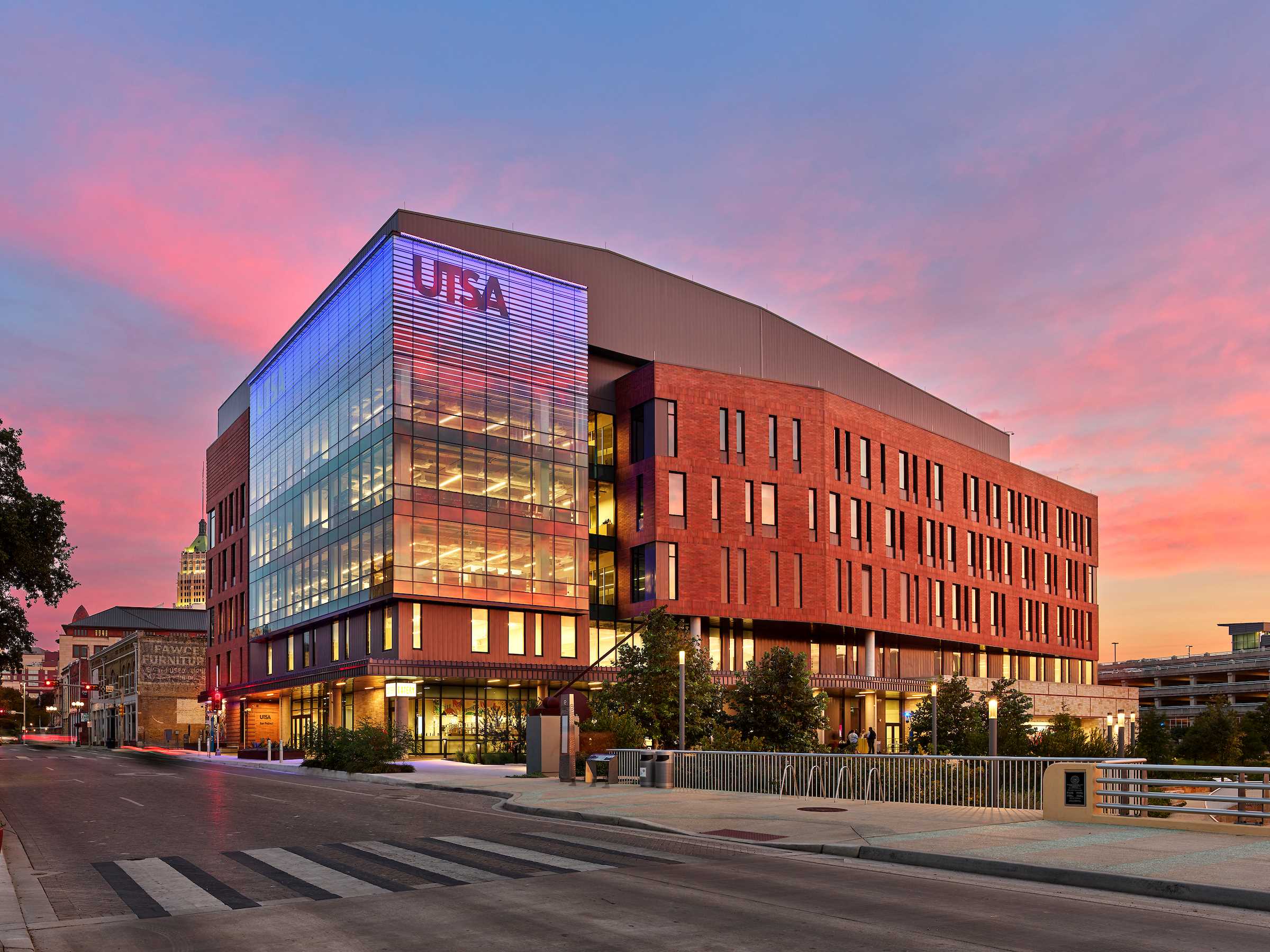



Organizing Committee


Greg P. Griffin
Research Coordinator, Oregon Department of Transportation
Testbed Operations and Deployment Lead


Anindya Maiti
Assistant Professor, University of Oklahoma
Outreach Coordinator and Backend Systems Lead
Sponsors & Partners




Contact
Questions about registration, proposals, or workshop fit: scooterlab@utsa.edu.